

Have you ever walked away from a conversation feeling completely misunderstood, or worse, full of a simmering resentment you didn’t know how to express? Or maybe you tend to “people-please” just to avoid a confrontation but feel exhausted and insignificant afterward.
Most of us weren’t taught how to navigate complex emotions or how to ask for what we need without sounding “demanding.” Yet, communication is one of the most powerful forces shaping our mental health and relationships.
Luckily, Non-Violent Communication (NVC) provides a highly effective and practical framework, which has been used in psychotherapy, schools, organizations, and mediation processes worldwide [1]. NVC is a tool that helps a person participate in difficult conversations with empathy, clarity, and mutual respect. Assertiveness or NVC is not something we are born knowing, rather It is a skill that can be learned and strengthened, with practice and professional support.
Why Do We Struggle With Being Assertive?
Many of us struggle with communicating in an assertive way because we don’t know how to, express our feelings, or ask for what we need without guilt or fear of rejection. We may feel that speaking in an assertive way may appear rude or seem aggressive or even selfish
The consequences?
We become trapped in a vicious cycle of staying quiet and engaging in people-pleasing, which may lead to feelings of self-doubt and resentment. These bottled up feelings may explode in an aggressive way leading to the cycle of low self-esteem, emotional dysregulation, and even relationship issues.
If you find communication overwhelming, working with a therapist can provide a safe space to practice new tools and address the anxiety or self-doubt underneath.
What Is Non-Violent Communication (NVC)?
Developed by psychologist Marshall B. Rosenberg in the 1960s, NVC—often called “Compassionate Communication”—is based on the principle of Ahimsa: the natural state of compassion when violence is absent from the heart.
Rosenberg used the giraffe as the symbol for NVC because it has the largest heart of any land mammal and can eat thorny acacia leaves without getting hurt. Symbolically, NVC gives us the “big heart” to listen with empathy and the “tough skin” to navigate thorny, difficult conversations without becoming defensive.
The goal of NVC is not to “win” an argument but to foster a connection in which everyone’s needs are valued. It shifts the focus from “Who is right and who’s at fault?” to “What are we feeling, and what do we need?”, creating a beautiful opportunity to strengthen our relationship with ourselves and others [2].
4 Pillars of Non-Violent Communication
NVC breaks communication down into four simple steps. Here is how you can apply them to your own life:
1: Observation
Describe what is happening without adding a “label” or a judgment. Think like a video camera: what would it record?
| Common Mistake | “You’re being lazy and ignoring me.” (Judgment, Assumption) |
| The NVC Method | “I noticed that you haven’t replied to my last three texts, and the dishes are still in the sink.” (Fact) |
| The Outcome | When we lead with facts, the other person is less likely to feel attacked and more likely to stay engaged in the dialogue. |
2: Feelings
Identify the specific emotion you are experiencing. You can try using the feeling wheel to pinpoint your inner experience. Be careful to avoid “faux-feelings”—words that actually describe what you think someone is doing to you (e.g., “I feel ignored”).
| Common Mistake | “I feel like you don’t care about my time.” |
| The NVC Method | “I feel frustrated and lonely.” |
| The Outcome | Expressing true vulnerability invites empathy rather than defensiveness. |
3: Needs
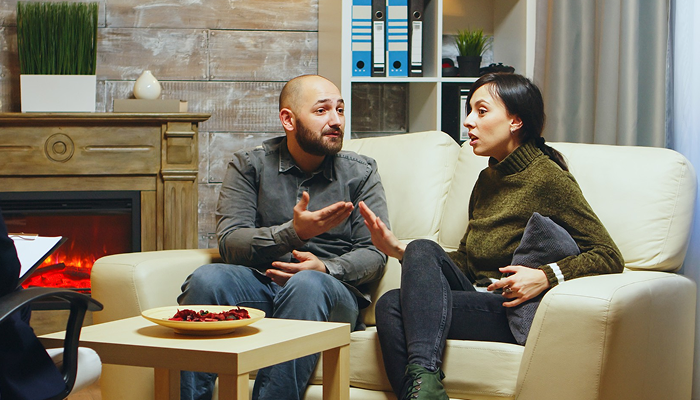
Every feeling is a signal that a need is either being met or neglected. For example, disappointment can be linked to a lack of reliability. Anxiety, in turn, may suggest that we need more reassurance.
| The Scenario | You’re upset because your partner stayed late at work again. |
| The NVC Method | “What I need is more connection and shared quality time with you.” |
| The Outcome | Connecting your feelings to your needs helps you take full responsibility for your experience and reduce blame. |
4: Requests
Ask for a specific, concrete action that would enrich your life. A request is only a request if you are prepared to hear a “no” and continue the dialogue.
| The Trap | “Stop working so much.” (Vague, passive demand) |
| The NVC Method | “Would you be willing to have dinner with me without your phone on Tuesday night?” (Specific request) |
| The Outcome | Replacing vague criticism with a “doable” roadmap reduces the listener’s defensiveness and helps them meet your needs without feeling controlled. |
Why Professional Psychological Support Matters
While NVC is a skill that can be taught and practice, using it in the heat of the moment can be incredibly difficult—especially if you are dealing with underlying trauma, chronic anxiety, or depression.
At Harbor Psychiatry & Mental Health, we offer a holistic approach to these challenges. You don’t have to navigate your relationships or your mental health journey alone. Let’s work together to build a life—and a language—that works for you. If you’re tired of feeling unheard or stuck in cycles of conflict, click here to reach out.
References
[1] Arieli, D., & Abboud Armaly, O. (2023). Nonviolent communication (NVC) based mediation: Practice insight. Conflict Resolution Quarterly, 40(3), 357–366. https://doi.org/10.1002/crq.21370
[2] Vazhappilly, J.J., Reyes, M.E.S. Non-Violent Communication and Marital Relationship: Efficacy of ‘Emotion-Focused Couples’ Communication Program Among Filipino Couples. Psychol Stud 62, 275–283 (2017).
