
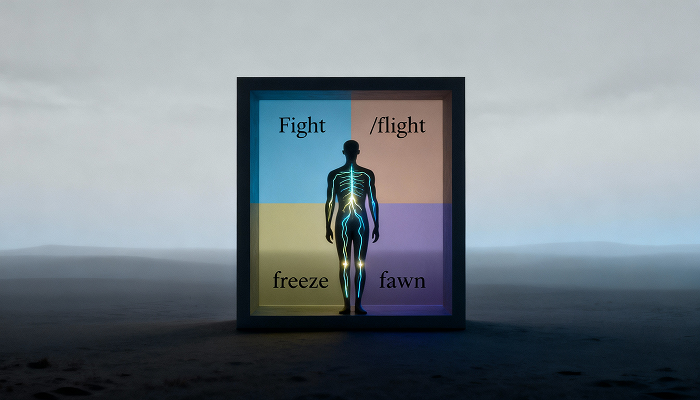
Have you ever wondered why you explode in anger over small things, why you avoid conflict at all costs, why you feel numb most days, or why you say “yes” when every part of you wants to say “no,”? You’re not broken, rather, you’re responding exactly the way your body learned it had to.
These responses – often simplified as “the 4 Fs” (fight, flight, freeze, fawn) – aren’t random or “weak.” They are natural survival mechanisms wired into our nervous systems. The problem arises when the danger is long gone, but the 4 F pattern persists. That’s when a chronic response quietly runs your life.
Good news? You can gently rewrite those old survival rules. And you don’t have to go through this alone.
What Is the Stress Response?
The moment your brain detects physical or emotional danger — real or perceived — it sounds the alarm and hijacks the wheel. Stress hormones flood your system, your heart races, breathing shallows, and logical thinking goes offline. This is the body’s hard-wired stress response doing its job, ensuring your survival.
This automatic reaction reflects our evolutionary design — fight-or-flight (or freeze) helped our ancestors survive predators and other life-threatening dangers. In modern times, while threats are rarely physical predators, our nervous systems may still react the same way when we sense emotional danger, relational stress, or internal triggers.
The 4 Fs: Fight, Flight, Freeze, or Fawn
Fight
| When is it activated? | Signs of Fight Response | Examples |
| Situations in which a threat is detected and assessed as small enough to confront. |
|
Snapping back, shouting, or confronting someone who keeps belittling you. |
Flight
| When is it activated? | Signs of Flight Response | Examples |
| Situations in which a threat feels overwhelming and too big to face, and escape seems possible. |
|
Leaving an argument abruptly. Avoiding friends after disagreement. Throwing yourself into work, hobbies, or constant busyness to avoid pain or conflict. |
Freeze
| When is it activated? | Signs of Freeze Response | Examples |
| Situations of danger, including social threat [1] , in which neither fight nor flight feels possible or safe. The nervous system essentially “presses pause.” |
|
Someone experiencing abuse or assault may “freeze” — unable to move, scream, or defend themselves. Later in life, a freeze may manifest as emotional numbing, chronic indecision, or dissociation under stress. |
Fawn
| When is it activated? | Signs of Fawn Response | Examples |
| Situations where interpersonal threat or danger is present — especially when aggression or flight could provoke more harm. The brain chooses appeasement in hopes of safety [2]. |
|
A person in an emotionally abusive or manipulative relationship may always agree, apologize, suppress feelings, or do everything to keep the peace — even when it harms them. |

The Mental Health Toll of Staying in Survival Mode
While the 4 Fs are adaptive in acute danger, when a person — especially children with complex PTSD — experiences repeated threat, harm, neglect, or abuse, these survival responses may become entrenched as default modes of operating. What once was protective becomes limiting or harmful.
1. Chronic Fight or Flight:
2. Chronic Freeze:
- disconnection, feelings of numbness or “emptiness,”
- difficulty feeling alive or connected,
- trouble making decisions or taking actions,
- zoning out/dissociative states
Read more about the blended state of functional freeze.
3. Chronic Fawning:
- difficulty setting boundaries,
- people-pleasing tendencies,
- challenges expressing needs or authentic self,
- difficulty with codependency in relationships,
- low self-worth,
- chronic stress from over-giving.
By living in a constant state of perceived threat, the nervous system may remain over-activated (or under-activated), and the body-mind connection becomes dysregulated — which can undermine well-being, functional capacity, and relationships.
The Path Towards Healing: Reach Out for Professional Help
If you recognize yourself in these patterns — whether you find yourself constantly reactive, chronically people-pleasing, emotionally “frozen,” or always on edge — know this: your reaction was never a sign of weakness. It was a human, automatic attempt to survive.
At Harbor Psychiatry & Mental Health, we believe in matching therapeutic treatment to the person — not forcing you into a one-size-fits-all model. Our compassionate team of mental health providers is ready to help you gently reconnect with your body, process past experiences, and find healing.
Contact us here.
Healing is possible — and you deserve a safe space, compassion, and support on that journey.
References:
[1] Noordewier, M. K., Scheepers, D. T., & Hilbert, L. P. (2019). Freezing in response to social threat: A replication. European Journal of Social Psychology, 49(7), 1375–1390. https://doi.org/10.1002/ejsp.2603
[2] Bailey, R., Dugard, J., Smith, S. F., & Porges, S. W. (2023). Appeasement: replacing Stockholm syndrome as a definition of a survival strategy. European Journal of Psychotraumatology, 14(1). https://doi.org/10.1080/20008066.2022.2161038
