

Imagine waking up not to the soft light of a sunrise, but to the sharp ping of a notification. Before you even manage to properly wake up and have your first sip of morning coffee, your brain is immediately bombarded with the endless stream of heartbreaking news from Gaza, Ukraine, Iran, and Sudan. Border tensions, political unrest, climate disasters, and economic instability…Never before have we been so easily and continuously exposed to the world’s most distressing events, all at once.
If you’re feeling increasingly anxious, overwhelmed, or hopeless, you’re not weak or overly sensitive. It’s a natural human response to a mind-boggling and unprecedented era of constant information. In times when you can be served news of global trauma for breakfast, straight from your phone, it’s of utmost importance to learn how to consume news without letting it consume you, and how to stay informed while supporting your mental health.
The Rise of Socio-Political Stress
According to the American Psychological Association, political stress rose from 52% in 2016 to nearly 70% by 2024 in the US alone [1]. So how can we explain this phenomenon?
Compared to previous generations, we now receive continuous updates through social media, news apps, and online platforms. We can watch live streams from all around the world, learn about global events from short-form videos taken out of context, or use ChatGPT to quickly get an answer without verifying its accuracy or checking its source. Not to mention the role of AI in fueling algorithms that amplify emotionally charged content, including deepfakes and misinformation, that keep us reactive rather than mindful [2].
How Socio-Political Stress Affects Our Mental Health?
Such high accessibility to the news significantly impacts both our mental and physical well-being. Here are some of the common issues we face:
| Symptoms | Description |
| Physical | Our bodies and nervous systems are affected by the onslaught of distressful news, often manifesting as headaches, muscle tension, difficulty falling or staying asleep, and general fatigue. |
| Emotional | In the face of all that distressing information, it’s common to struggle with feelings of hopelessness, anxiety, restlessness (feeling “on edge”), and irritability [3]. |
| Behavioral | Engaging in compulsive news checking and doomscrolling can, in turn, increase rumination, difficulty focusing and making decisions, or lead to social withdrawal and/or isolation. |
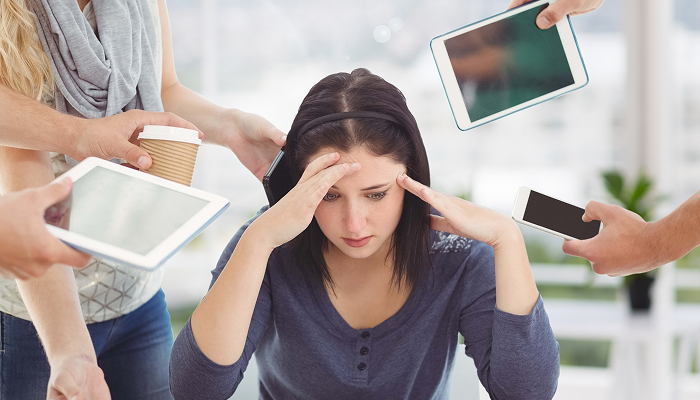
Navigating Socio-Political Stress Mindfully
1: Set Digital Boundaries
Choosing to stay informed doesn’t mean mindlessly consuming any and every piece of content online, but rather proactively choosing a couple of reputable, trusted information sources. To put it shortly: don’t let the information come to you – seek it out. Be an active consumer of information rather than a passive recipient.
In addition, choose specific times to check the news rather than consuming it throughout the day. Decide on a 15 or 30-minute daily time limit, and notice the improvement in your emotional well-being.
2: Focus on Things Within Your Control
At the core of dealing with the socio-political stress is the fear of the unknown, the anxiety fueled by the uncertainty, the uncharted territory of tomorrow. When we’re shocked by distressing news, our nervous system can, time and again, learn to brace for impact, even when we’re objectively safe. Such a hypervigilant stress response is our nervous system’s attempt at dealing with all those things that are out of our control. However, that can further reinforce the worries and feelings of helplessness and hopelessness.
If that feels familiar, imagine your life if you intentionally redirected your attention and efforts toward those things you can control, activities you could engage in, spaces where you could see the impact of your actions, etc. Here are a couple of examples to start with:
- Building and maintaining a healthy morning routine fosters your own piece of stability and predictability amidst all the uncertainty and chaos.
- Moving your body regularly and maintaining a consistent sleep schedule can help your nervous system down-regulate.
- Contributing to causes you care about in manageable ways, such as volunteering, protesting, signing petitions, or having difficult conversations, can all restore a sense of purpose.
3: Seek Connection, Not Division
Spending time with trusted friends, family, or community members can reduce feelings of helplessness and isolation. If, at any point, a conversation about a distressing event becomes hostile, remember that you have every right to protect yourself and end it. Seek connection – not division.
If you’re struggling with emotional exhaustion or stress in the face of current events, you do not have to carry this weight on your own. Our team of mental health professionals is here to help. In the world of uncertainty, therapy offers stable and reliable support as well as:
- tools to manage rumination, stress, and anxiety,
- new ways to process complex emotions,
- an opportunity to build routines that help you regain a sense of groundedness.
Seeking help is a very brave, proactive step toward achieving greater inner balance. And it starts here.
References:
[1] American Psychological Association. (2024). Stress in America™ 2024: A nation in political turmoil.
[2] Ofcom. (2024, July 23). Deepfake defences: Mitigating the harms of deceptive deepfakes (Discussion paper).
[3] Kellerman, J. K., Hamilton, J. L., Selby, E. A., & Kleiman, E. M. (2022). The mental health impact of daily news exposure during the COVID-19 pandemic: Ecological momentary assessment study. JMIR Mental Health, 9(5), e36966.
